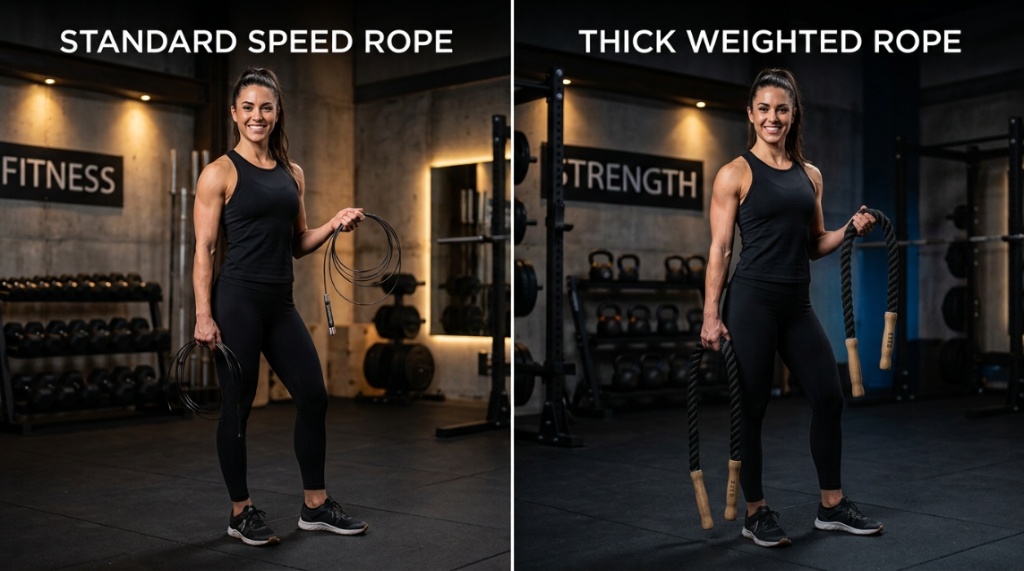
You have the shoes, the playlist, and the motivation. But when you grab a rope, you feel a pang of doubt. Is a lightweight speed rope better for your goals, or is a heavy, slow-moving weighted rope the real game-changer? This decision stalls thousands of workouts every single month. You are not alone in feeling stuck between two tools that look similar but behave completely differently. The jump rope vs weighted rope debate isn’t about which one is “better”—it is about which one fits your specific fitness outcome, your skill level, and the time you have available. This guide breaks down the physics, the muscle engagement, and the practical results of each, helping you make a confident choice so you can stop thinking and start jumping.
What Physically Happens When You Use a Lightweight Speed Rope?
Velocity and Coordination Demands
A lightweight speed rope, typically made of PVC or wire, weighs under 100 grams. Because the mass is minimal, you must generate high rotational speed to keep the rope moving. This forces your wrists, forearms, and shoulders to fire rapidly. The fast cadence demands precise timing. You cannot muscle through a mistimed jump; the rope hits your shins immediately. This builds incredible neuromuscular coordination and agility over time.
Cardiovascular Response and Workload
With a light rope, your heart rate skyrockets quickly. To maintain 120–160 revolutions per minute, your oxygen demand spikes. Studies show that just 10 minutes of high-speed jump roping can produce a cardiovascular stimulus equivalent to 30 minutes of jogging. The low mass means you are fighting air resistance and gravity with rotation speed, not weight. This leads to a high-intensity, low-impact aerobic workout that improves VO2 max efficiently.
Joint Impact and Landing Mechanics
Light ropes encourage a soft, springy landing. Because you are focusing on rhythm and speed, your landings become lighter and more controlled. You naturally stay on the balls of your feet. This reduces the risk of shin splints and knee strain compared to heavier, slower options. Boxers and MMA fighters often use lightweight ropes because they mimic the footwork demands of the ring without adding unnecessary load to the joints.
What Physically Happens When You Use a Weighted Jump Rope?
Increased Muscle Activation Through Load
Weighted ropes range from 227 grams (half a pound) to 1.8 kilograms (four pounds). The extra mass changes the physics entirely. Your arms, shoulders, and upper back must work harder to overcome inertia and bring the rope over your head. The lats, traps, and rear deltoids engage significantly more than with a light rope. Electromyography (EMG) studies on weighted rope training show a 30–40% increase in upper body muscle activation compared to standard speed ropes.
Slower Tempo and Strength-Endurance
You cannot swing a heavy rope at 150 RPM. The pace naturally drops to 80–100 RPM. This slower tempo shifts the energy system demand from pure anaerobic power to a mix of strength and endurance. Your muscles experience longer time under tension. This makes weighted ropes excellent for building muscular endurance in the shoulders and grip strength. You will feel a burn in your forearms and lats that a light rope simply cannot replicate.
Proprioceptive Feedback and Form
Heavy ropes provide undeniable sensory feedback. You feel exactly where the rope is in space. This tactile feedback helps beginners who struggle with timing, because the slower rotation gives them more time to process and react. However, the increased mass also increases impact if you land hard. Landing mechanics become even more critical, as the heavier rope can pull you forward if your posture breaks down.
Which Rope Burns More Calories: Speed Rope or Weighted Rope?
Caloric Expenditure per Minute
Both ropes burn significant calories, but the mechanism differs. A lightweight speed rope burns approximately 10–16 calories per minute for a 70 kg person, depending on intensity. A weighted rope (0.5–1 kg) burns roughly 12–20 calories per minute due to the added resistance on the upper body. The weighted rope burns slightly more, but the difference is not massive unless you maintain high quality form with the heavy rope,If you prefer exercising outside at home, ensuring your outdoor living space is protected from the elements is just as important as your workout gear. For local homeowners looking to upgrade their exterior setups, checking out resources like Most Underrated Roof Features Roofing Companies Huntsville AL can help protect your backyard training area year-round.
Sustainable Duration and Total Output
The real key is sustainability. Most people can jump a speed rope for 15–20 minutes continuously with practice. A weighted rope often fatigues the upper body before the legs give out, limiting session duration to 8–12 minutes. Total caloric burn over a full session may actually favor the speed rope because you can go longer. If you are chasing total energy expenditure over 30 minutes, the speed rope wins. If you want a high-calorie burn in a short 8-minute window, the weighted rope is superior.
Afterburn Effect (EPOC)
Weighted ropes create more muscular microtrauma in the shoulders and arms due to the increased load. This can lead to a slightly higher excess post-exercise oxygen consumption (EPOC) for up to 24 hours post-workout. For fat loss enthusiasts, this subtle metabolic elevation makes the weighted rope a strong tool when combined with proper nutrition. However, EPOC differences are marginal and should not be the sole deciding factor.
How Does Rope Weight Affect Grip Strength and Forearm Development?
Grip Demands of a Light Speed Rope
Speed ropes require a light, relaxed grip. Squeezing too tightly causes premature forearm fatigue and slows rotation speed. The grip works isometrically but with low intensity. You develop what is called “endurance grip” — the ability to hold on for a long time without crushing force. This is beneficial for athletes who need sustained grip for climbing, rowing, or martial arts.
Grip Demands of a Weighted Rope
Weighted ropes demand a firm, active grip. The heavier handle and cable require constant volitional contraction to maintain control during rotation. Over weeks, this builds significant crushing grip strength and forearm hypertrophy. Rock climbers, wrestlers, and strongman athletes often incorporate weighted ropes specifically for this reason. The difference is palpable: after a 10-minute session with a 1 kg rope, your forearms will feel pumped in a way a speed rope cannot match.
Practical Progression Strategy
Start with a speed rope to build neural adaptation and wrist endurance. Once you can jump for 5 minutes without tripping, add a light weighted rope (0.25–0.5 kg) for 2-minute intervals. This allows your connective tissues to adapt to the increased load without risking tendinitis. Progressing from speed to weight slowly prevents overuse injuries in the wrist extensors and flexors.
Which Rope Is Better for Beginners: Jump Rope vs Weighted Rope?
The Case for Starting with a Speed Rope
Beginners should almost always start with a lightweight speed rope. The low mass means mistakes (trips and catches) have minimal impact on momentum and do not hurt as much when they hit your legs. You can build the fundamental motor pattern of wrist rotation and foot timing without fighting the weight. A speed rope allows you to practice for longer periods, which accelerates skill acquisition.
The Case for Using a Light Weighted Rope
Some beginners with coordination challenges benefit from a light weighted rope (0.25 kg). The tactile feedback helps them feel where the rope is, reducing the “casting” error where the rope looks like a U shape instead of a smooth arc. However, this is a niche benefit. A standard speed rope remains the most forgiving and versatile tool for learning basic bounce steps, boxer steps, and alternate foot jumps.
Avoiding a Common Beginner Mistake
Many beginners buy a heavy weighted rope (1 kg or more) thinking it will build muscle faster. This often backfires. The heavy rope forces poor posture—rounded shoulders, forward lean, and heavy landings—because the arms cannot sustain the rotation. This ingrains bad mechanics that are hard to undo. Master the speed rope first; add weight only when your technique is solid for 100 consecutive jumps without a miss.
Can You Build Muscle with a Weighted Jump Rope Alone?
Muscle Groups Targeted
Weighted ropes primarily build muscle endurance, not maximal strength. You will develop noticeable hypertrophy in the forearms, rear deltoids, and traps over 8–12 weeks. Some individuals see arm definition improve as the upper body muscles work continuously against resistance. However, you cannot build significant leg muscle from jumping alone. The legs work aerobically, not under heavy load, so quad and glute growth will be minimal.
Supplemental Role in a Strength Program
Think of a weighted rope as a finisher, not a primary builder. Use it after your main lifts (squats, deadlifts, presses) to drive blood into the shoulders and improve work capacity. This improves your ability to recover between heavy sets. It also strengthens the rotator cuff muscles, which helps prevent shoulder injuries from pressing exercises. The rope is a tool for density and conditioning, not a replacement for barbells or dumbbells.
When to Use Weighted Ropes for Muscle
If your goal is visible upper body conditioning and vascularity, the weighted rope is excellent. Professional physique athletes often use them to bring out forearm and shoulder striations before competitions. For general muscle growth, combine the rope with resistance training. A balanced approach looks like this: 3 minutes of speed rope for warm-up, 3 minutes of weighted rope for upper body pump, then your main strength workout.
How Does Rope Material Change the Workout Experience?
PVC and Wire Speed Ropes
PVC ropes are durable, affordable, and cut through the air quickly. They are best for indoor use on smooth surfaces like gym floors and mats. Wire speed ropes (coated steel cable) are faster and more durable but can hurt significantly if they hit your legs. They are designed for competitive jumpers who need maximum speed with minimum air drag. Neither is well-suited for outdoor concrete; the material wears down quickly and feels “dead” on rough surfaces.
Beaded and Nylon Weighted Ropes
Beaded ropes offer moderate weight with excellent durability. The beads create a distinctive sound that helps with timing, making them popular in CrossFit and boxing gyms. Nylon weighted ropes are softer and quieter, making them better for home use or early morning workouts. Both materials provide more feedback than PVC, helping you maintain rhythm without looking at your feet.
Selecting Based on Your Environment
Choose a PVC speed rope for gym use and a nylon weighted rope for home use. If you train outdoors, a beaded rope holds up best against asphalt and concrete. The material determines not just feel but also lifespan and noise level. Consider your training location seriously before buying, as a mismatch here can make the jump rope vs weighted rope decision moot if neither suits your space.
When Should You Use a Jump Rope vs. a Weighted Rope in Your Training Week?

Speed Rope for Active Recovery and Skill Work
Use the speed rope on days when your nervous system is fatigued from heavy lifting or intense sport practice. The light rope allows you to groove movement patterns without taxing your muscles. Schedule speed rope sessions for 10–15 minutes at low to moderate intensity on your recovery days or before your main workout as a neural activation warm-up. The rapid wrist rotation wakes up the central nervous system without exhausting your legs.
Weighted Rope for Strength-Endurance Sessions
Reserve the weighted rope for days when you want to push muscular endurance. The best programming is interval-based: 30 seconds of jumping, 30 seconds of rest, repeated 8–10 times. This mimics the demands of sports like boxing, wrestling, and functional fitness. Use it after your compound lifts or as a standalone conditioning session on days you cannot make it to the gym for weights.
Periodization for Progress
Rotate between the two ropes every 4 weeks. Spend one month focusing on speed, agility, and footwork with the light rope. The next month, shift to weighted rope for upper body endurance and grip strength. This prevents adaptation, keeps your body guessing, and ensures balanced development. Without periodization, you risk overdeveloping one energy system while neglecting the other.
What Are the Common Myths About Weighted Ropes?
Myth: Weighted Ropes Are Only for Advanced Athletes
This is false. Light weighted ropes (0.25–0.5 kg) are excellent for beginners who need more sensory feedback. The key is choosing the correct weight, not avoiding weight altogether. Many physical therapists prescribe very light weighted ropes for shoulder rehabilitation because the controlled rotational movement improves scapular stability.
Myth: Heavier Ropes Always Mean Harder Workouts
Not necessarily. A heavy rope slows down your cadence, which can actually lower your heart rate if you do not compensate by jumping higher or adding movements. The difficulty comes from muscular fatigue, not cardiovascular demand. A speed rope at 150 RPM is often more challenging from a cardiovascular perspective than a heavy rope at 80 RPM. “Harder” depends on your specific fitness metric.
Myth: You Need a Heavy Rope to Get in Shape
Untrue. Many elite athletes are in phenomenal shape using nothing but a speed rope. The rope type matters far less than your consistency, intensity, and form. A beginner jumping a speed rope for 20 minutes daily will see better results than someone buying a heavy rope and using it for 3 minutes once a week. Focus on adherence over equipment specifications.
Frequently Asked Questions
Is a weighted jump rope better for calves?
No. Calf engagement is similar between speed ropes and weighted ropes because the calves activate during the jump itself, not the rope swing. If you want bigger calves, focus on jumping height and single-leg variations rather than rope weight.
Can I use a weighted rope for double unders?
It is very difficult. Weighted ropes rotate too slowly to complete two passes under your feet in one jump. Most athletes use speed ropes for double unders. If you want to learn double unders, stick with a PVC or wire speed rope.
Does a heavier rope hit harder when you mess up?
Yes, significantly. A 1 kg rope striking your shins or ankles causes more pain and potential bruising than a 100 gram speed rope. Beginners and those with low pain tolerance should start with lightweight options until their timing is reliable.
How long until I see results with a weighted rope?
Visible upper body conditioning often shows in 4–6 weeks with consistent use (4–5 sessions per week). Cardiovascular improvements appear within 2–3 weeks. Results depend heavily on your diet, sleep, and overall training volume, not just the rope type.
Can I alternate between both ropes in one session?
Yes, and this is actually one of the most effective training methods. Start with 3 minutes of speed rope for warm-up, perform your main workout, then finish with 3–5 minutes of weighted rope for upper body endurance. This gives you the benefits of both tools in a single session.
Are weighted ropes bad for your elbows?
They can be if you lock your elbows or use too heavy a rope too quickly. Maintain a slight bend in your elbows and keep the rotation in your wrists, not your shoulders or elbows. If you feel elbow pain, reduce the weight of the rope immediately and check your technique.
Do professional boxers use weighted ropes?
Most professional boxers use lightweight speed ropes for footwork and conditioning. Some incorporate light weighted ropes (0.25–0.5 kg) to strengthen the shoulders and wrists for punching endurance, but heavy weighted ropes are rare in boxing gyms due to the slower footwork they encourage.
The decision between a speed rope and a weighted rope comes down to your specific goal. If you want to build agility, speed, and cardiovascular endurance while learning a new skill, the speed rope is your clear winner. If you want to strengthen your upper body, improve grip strength, and add muscle density to your shoulders and arms, the weighted rope delivers results the speed rope cannot. The best solution is to own both and rotate them strategically based on your weekly training focus. Start with a quality speed rope to build your foundation, then add a lightly weighted rope as you progress. Your fitness journey is unique—choose the tool that moves you toward your goal, not the one that looks impressive on a shelf. Grab a rope, step on the center, and start moving.