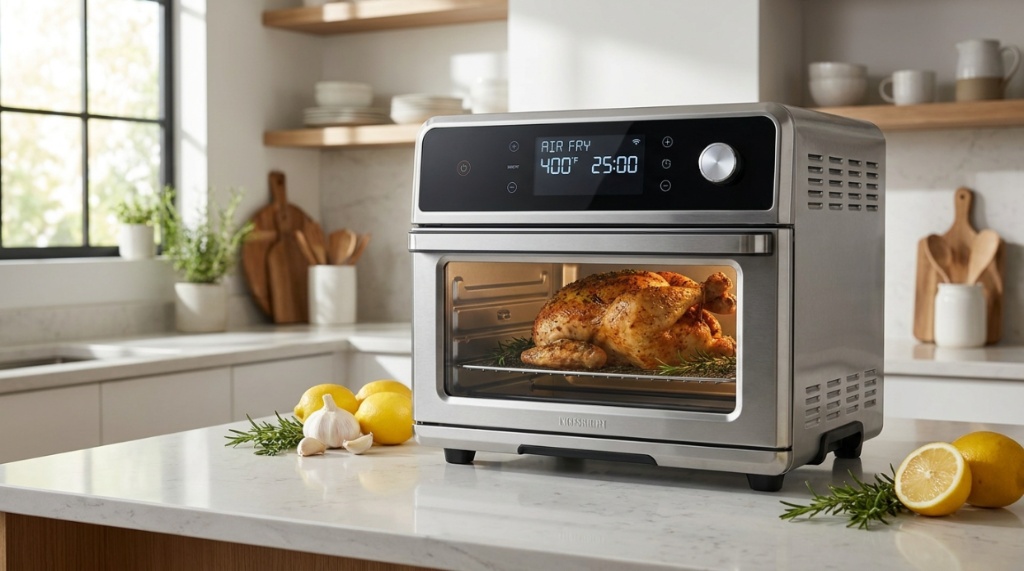
The price gap between a basic $45 air fryer and a $700 premium smart oven is so wide that most buyers freeze mid-purchase — unsure whether the extra hundreds genuinely buy better cooking or just shinier marketing. Choosing an affordable smart air fryer oven for your home means finding the price point where genuine smart features (app control, probe integration, recipe automation) meet quality construction — without paying the premium-brand tax that adds brand prestige rather than cooking performance. An affordable smart air fryer oven is a WiFi-connected countertop convection appliance priced between $100 and $250 that delivers meaningful smart functionality — automated cooking programs, app-based remote control, and intelligent temperature management — at household-budget-friendly pricing. The trap buyers fall into? Either overpaying for brand names that deliver identical cooking technology in fancier packaging, or underpaying for “smart” models where WiFi connectivity is a cosmetic addition to fundamentally underpowered cooking hardware. This guide maps exactly where the affordable smart air fryer oven sweet spot lives — and how to identify models that punch above their price class.
What Does “Affordable” Actually Mean for Smart Air Fryer Ovens?
Affordable means $100–$250 — the range where genuinely smart features exist alongside adequate cooking performance, without the $300–$700 premium that brand positioning, exotic materials, and advanced AI add to high-end models.
What each budget tier delivers:
| Price Range | Smart Features | Cooking Performance | Build Quality | Best For |
|---|---|---|---|---|
| Under $100 | None or Bluetooth-only (minimal value) | Basic — adequate air frying, limited versatility | Light construction, 2-year lifespan | Testing if you’ll use an air fryer at all |
| $100–$150 | WiFi + basic app, limited presets, timer notifications | Good — proper air frying, multi-function | Moderate — 2–3 year daily use | Budget-conscious buyers wanting real smart features |
| $150–$250 (sweet spot) | Full WiFi, quality app, probe support, recipe libraries, OTA updates | Very good — even heating, proper convection, multiple functions | Solid — 3–4 year daily use | Most buyers wanting smart + quality without premium pricing |
| $250–$400 | Advanced smart + premium build | Excellent | Premium — 4–5 year daily use | Enthusiasts and daily heavy users |
The $150–$250 range represents the genuine affordable smart sweet spot. Below $150, smart features are too basic to deliver meaningful daily convenience. Above $250, you’re entering premium territory where additional spending buys refinement rather than fundamental capability improvements. At $150–$250, you get real WiFi with real app ecosystems, real temperature probes, real multi-function cooking — just without the luxury packaging and bleeding-edge AI of $500+ models.
Which Affordable Smart Air Fryer Ovens Deliver the Best Value?
The best value affordable smart air fryer ovens currently are: Cosori Smart Air Fryer Oven (best app ecosystem at the price), COSORI Air Fryer Toaster Oven Combo (best multi-function value), and Ninja Foodi Digital Air Fry Oven (best cooking performance per dollar).
Top affordable picks:
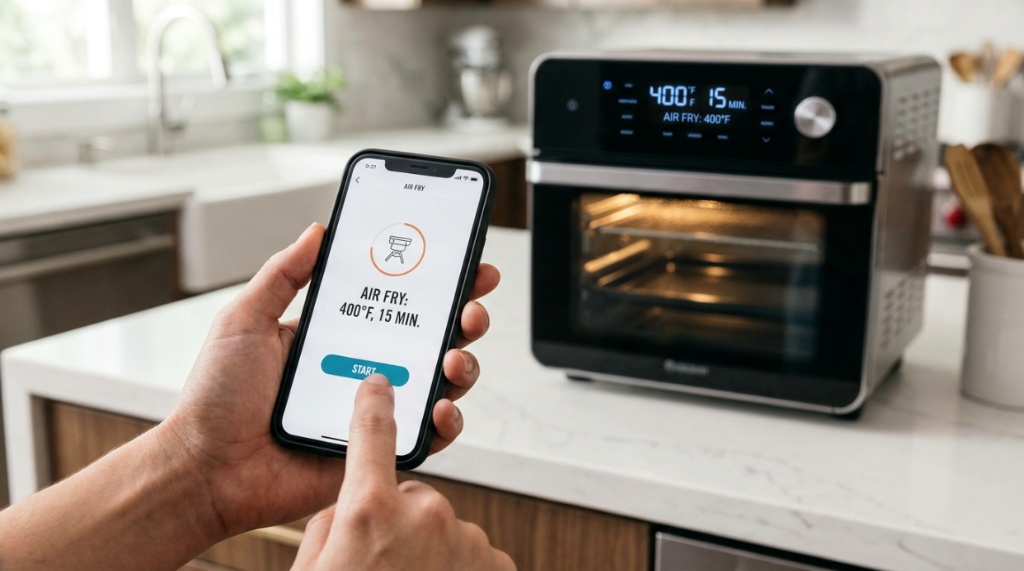
- Cosori Smart Air Fryer Oven 30L ($180–$230): VeSync app with excellent rating (4.5+ stars), 12 cooking functions, dual heating elements, 1800W for proper air frying power, non-stick interior. The app delivers remote control, 100+ recipes sent directly to the oven, and over-the-air updates. Best smart experience under $250.
- Ninja Foodi Digital Air Fry Oven ($150–$200): 1800W, flip-up design saves counter space when not in use, 10 cooking functions, digital precision controls. Smart features are less advanced than Cosori (no full app ecosystem on base model) but cooking performance is excellent — particularly even air frying and accurate temperature control.
- Instant Omni Plus Smart ($150–$200): Connected to Instant Brands app with recipe integration. 11 functions including air fry, roast, bake, broil, toast, dehydrate, proof. EvenCrisp technology for consistent results. Good smart integration at accessible pricing.
- Chefman Smart Air Fryer Oven ($120–$160): Budget-friendly entry into smart air frying. WiFi connected, app-controlled presets, adequate 1700W power. Build quality is a step below Cosori/Ninja but smart features work reliably for the price. Best under $150 smart option.
Value comparison methodology: divide the number of genuinely useful cooking functions by price to get a “function per dollar” ratio. Then multiply by app quality rating (1–5 scale from app store). This weighted calculation consistently ranks Cosori and Ninja highest in the affordable tier.
What Smart Features Should You Demand at Affordable Prices?
At $150–$250, you should demand: full WiFi connectivity (not Bluetooth-only), a companion app rated 4.0+ stars, at least 8 cooking presets, timer and temperature notifications to phone, over-the-air updates, and compatibility with voice assistants (Alexa or Google).
Non-negotiable smart features at affordable tier:
- WiFi (not Bluetooth): WiFi enables remote operation from anywhere in your home (or away). Bluetooth limits range to 30 feet — useful only when standing next to the oven anyway. At $150+, WiFi should be standard. Reject Bluetooth-only “smart” models at this price.
- Quality companion app (4.0+ stars): Download the app before buying. If it’s poorly rated (under 3.5 stars), the smart features will frustrate rather than help. Look for: reliable connectivity, intuitive interface, recipe integration, and recent update dates (within 60 days).
- Push notifications: Phone alerts when cooking completes, when preheat reaches target, or when probe hits temperature. Without notifications, “smart” connectivity provides no advantage over standing in the kitchen watching a basic timer.
- Voice assistant support: Alexa or Google Home integration for hands-free operation. At affordable pricing, expect basic commands (preheat, start, stop, timer) rather than full recipe execution — but even basic voice control adds meaningful convenience.
- Over-the-air updates: The oven should improve over time through software updates. Verify the brand’s update history — if they’ve issued updates in the past 6 months, they’re actively supporting the ecosystem. No updates for 12+ months suggests abandoned support.
Features that are nice-to-have but not expected at affordable pricing: internal camera, AI food recognition, temperature probe (some include, many don’t at this tier), multi-zone cooking, and advanced learning algorithms that adapt to your preferences.
How Do You Avoid Cheap Models That Waste Money?
Avoid models that advertise “smart” but deliver only a WiFi chip added to fundamentally underpowered cooking hardware — identifiable by: wattage under 1500W, single heating element, app ratings below 3.5 stars, and missing safety certifications (ETL, UL).
Red flags that identify waste-of-money models:
- Under 1500W in a 25+ quart oven: Insufficient power to maintain air frying temperatures when loaded with food. Results in steaming rather than crisping — defeating the primary purpose. Minimum 1700W for 25+ quart family-size models; 1500W acceptable only for compact (under 20 quart) units.
- Single heating element: Top-only element means food must be flipped mid-cook for even browning. This manual step contradicts the “set and forget” promise of smart cooking. Dual elements (top + bottom) are standard at $150+ and should be non-negotiable.
- No-name brands without safety certification: Missing ETL, UL, or equivalent safety listing means the appliance hasn’t been independently tested for electrical safety. Kitchen appliances running at 1800W without certified safety testing represent genuine fire and shock risk. Always verify safety listing — visible on the product label or listing page.
- App store rating below 3.5 stars: A terrible app means your “smart” investment delivers a frustrating experience rather than a convenient one. Common complaints in low-rated apps: constant disconnection, crashes, inability to find oven on network, and slow/unresponsive controls.
- “Smart” through Bluetooth only: Bluetooth connectivity at $150+ pricing is unacceptable in 2025. The range limitation (30 feet, line-of-sight degradation) makes remote operation unreliable. Budget brands add Bluetooth chips cheaply to justify “smart” marketing at minimal engineering cost. Demand WiFi.
- No mention of update capability: If the product listing never mentions firmware updates or app improvements, the smart features are “ship and forget” — whatever issues exist at launch remain forever. Active brands prominently advertise ongoing support as a selling point.
How Does Affordable Compare to Premium in Daily Cooking Results?
Affordable smart air fryer ovens ($150–$250) deliver 85–90% of premium model ($400–$700) cooking results — with the remaining gap appearing primarily in temperature precision (±5°F vs ±2°F), cooking evenness across full capacity, and speed of smart feature response.
Performance gap analysis:
- Air frying crispiness: Affordable models produce excellent crispy results when properly loaded (70% capacity max). Premium models maintain crispiness even at full capacity and handle delicate items (fish, thin vegetables) with slightly better precision. Gap: 5–10% quality difference.
- Temperature accuracy: Affordable models hold ±5–8°F of target (acceptable for most cooking). Premium models hold ±2–3°F (matters primarily for precision baking and sous-vide-style cooking). For daily family cooking (proteins, vegetables, reheating), this gap is rarely noticeable in final results.
- Even heating at capacity: Affordable models may develop mild hot spots when fully loaded (requiring occasional rotation for perfect results). Premium models with multiple independently controlled elements maintain evenness regardless of load. Gap: matters for batch cooking and baking, minimal for standard meals.
- App responsiveness: Premium apps respond in under 1 second. Affordable apps may take 2–4 seconds for commands to register. Not a cooking quality issue — but a user experience difference that some find frustrating during frequent interactions.
- Build/longevity: Premium models last 4–5+ years of daily use. Affordable models last 3–4 years. The 1–2 year lifespan difference means replacing an affordable model once costs roughly the same as buying one premium model — but you get technology upgrades with each replacement rather than aging hardware.
Bottom line: for 90% of home cooking tasks (air frying, roasting, baking, reheating), an affordable smart air fryer oven produces results indistinguishable from premium models to most palates. The premium gap matters primarily for precision baking, professional-level cooking, and the patience-sensitive user experience of faster app response.
When Should You Spend More vs. Stick With Affordable?
Stick with affordable ($150–$250) if you cook standard family meals, use air frying primarily, and value function over luxury. Spend more ($300+) only if you bake precision pastries, need camera-based monitoring, cook professionally at home, or want maximum lifespan from a single purchase.
Decision framework:
- Stay affordable if: Your cooking is 70%+ air frying and roasting, you don’t bake precision pastries, you’re comfortable replacing appliances every 3–4 years (getting technology upgrades each time), your budget is defined, and you’re satisfied with 85–90% of premium cooking results.
- Spend more if: You bake bread/pastries requiring ±2°F accuracy, you want an internal camera for monitoring without opening the door, you cook 3+ meals daily and need maximum build longevity, you’ve confirmed through affordable model ownership that you’ll use smart features extensively, or you simply prefer buying once at premium rather than replacing periodically.
Investing in the right appliance makes kitchen multitasking effortless. While your new appliance perfectly crisps your main dish, you can easily whip up a refreshing beverage to complement your meal. Trying a quick and healthy Watermelon Smoothie Recipe is a fantastic, no-cook way to balance out a warm, air-fried dinner on a busy weeknight.
Conclusion
Affordable smart air fryer ovens ($150–$250) deliver genuine smart cooking intelligence — app control, remote operation, recipe automation, and precision monitoring — at pricing accessible to any household budget. The cooking performance gap between this tier and premium models is genuinely small (5–10%) for standard home cooking tasks, making affordable models the rational choice for most families who want smart features without luxury pricing.
Focus your evaluation on: adequate wattage (1700W+ for family size), full WiFi connectivity (not Bluetooth), a quality app (4.0+ stars, recently updated), dual heating elements, and safety certification. Avoid models that add WiFi to underpowered hardware — the “smart” label means nothing if the oven can’t properly crisp food. At $150–$250, excellent options exist from Cosori, Ninja, and Instant Brands — each delivering the smart kitchen experience without demanding a premium kitchen budget.
Frequently Asked Questions
What’s the best affordable smart air fryer oven under $200?
The Cosori Smart Air Fryer Toaster Oven ($180–$200) delivers the best combination of smart features (VeSync app, WiFi, voice control, OTA updates), cooking performance (1800W, dual elements), and capacity (30L family size) under $200. Its app ecosystem is the most polished in this price range, and the brand maintains active software support with regular updates.
Are budget smart air fryer ovens reliable?
Brands in the $150–$250 range from established companies (Cosori, Ninja, Instant, Cuisinart) are generally reliable for 3–4 years of daily use. Under $100, reliability drops noticeably — cheaper components, thinner construction, and abandoned app support create frustration. Stick with recognizable brands that have customer service infrastructure and warranty programs rather than unknown brands offering suspiciously low prices.
Do affordable models get software updates like premium ones?
Some do, some don’t — and this varies by brand rather than price. Cosori (VeSync app) and Instant Brands provide regular updates across their affordable lineup. Other brands at similar pricing may ship a functional app and never update it again. Check the specific app’s update history in your app store before purchasing — this is the most reliable predictor of ongoing smart support.
Can I add a temperature probe to an affordable model that doesn’t include one?
Not reliably. Temperature probe integration requires specific hardware connections and software support built into the oven’s design. External wireless meat thermometers (ThermoWorks, MEATER) work alongside any oven — providing probe functionality through a separate device and app. This is often a better solution than paying $100 more for a built-in probe in a premium model.
Is it worth buying a refurbished premium model instead of a new affordable one?
Sometimes — refurbished Breville or Ninja premium models at 40–50% off retail can deliver premium features at affordable pricing. Verify: manufacturer-refurbished (not third-party), includes warranty (minimum 90 days), and check that smart features still receive software support for that model year. The risk is shorter warranty and potential cosmetic wear — but cooking performance is identical to new.
How much counter space do affordable models need?
Most affordable family-size smart air fryer ovens (25–30 quart) require 20–24 inches of counter width and 16–18 inches of depth, plus 4–6 inches of clearance on sides, the back, and top. Total footprint with clearance: approximately 28–32 inches wide by 22–24 inches deep. Measure your intended location before purchasing—returns for space issues are common and frustrating.